
The most common reason a community cleanup never happens is not money, permits, or bags. It is that everyone who thought of it assumed somebody more official was supposed to do it.
Luke Mickelson founded Sleep in Heavenly Peace, which builds and delivers beds to children who do not have one. He is not in the cleanup business and he has no connection to what we do. But his interview on Unscripted Small Business contains the single best answer we have heard to the question that stops most first-time organisers, which is some version of: who am I to start this?
Some Dad In Some Podunk Town Got Off The Couch
Luke’s organisation began in his garage. He built a bunk bed with his own kids, posted on a local Facebook buy and sell group offering it to a child who did not have one, and was buried in replies from people who all knew a child sleeping on a floor. He had lived in his town for twenty-nine years and had no idea the problem existed.
What he is careful about, years later, is not letting anyone treat him as exceptional:
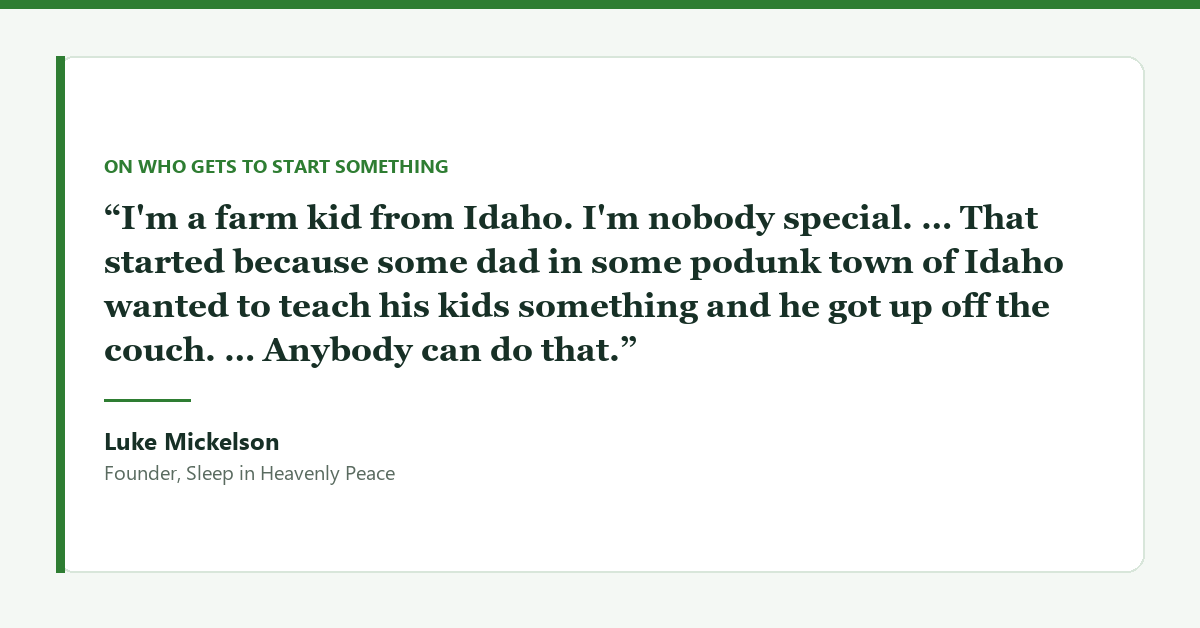
He insists on this because he does not want anyone watching him on a podcast to walk away with an excuse. The founding qualification was not a nonprofit background or a budget. It was a Saturday and a decision.
Elsewhere in the same conversation he explains what he thinks the person who starts actually gets out of it: “I believe true joy comes when you stop thinking about yourself and you start thinking about someone else, right? Because what happens is your problems don’t go away.” They do not disappear, in his framing. They just change size once you have spent a morning on somebody else’s problem instead.
That is transferable to a roadside, a creek bank, or a school car park. Nobody is coming. The permission you are waiting for does not exist.
Why The Chapter Model Scales Volunteers
The more useful half of Luke’s story, for anyone thinking about recurring events, is structural rather than motivational. He worked out early that one person cannot solve a problem that exists in every town at once. So he stopped trying to, and built something that teaches other people to run it where they live.
At the time of his interview he described having trained more than 440 chapter presidents across almost every US state and four countries, with roughly 400,000 beds built since 2018 and more than 160,000 children still on the waiting list. His organisation covered about 28 percent of the United States geographically. Those numbers will have moved since, but the shape of the thing is the point.
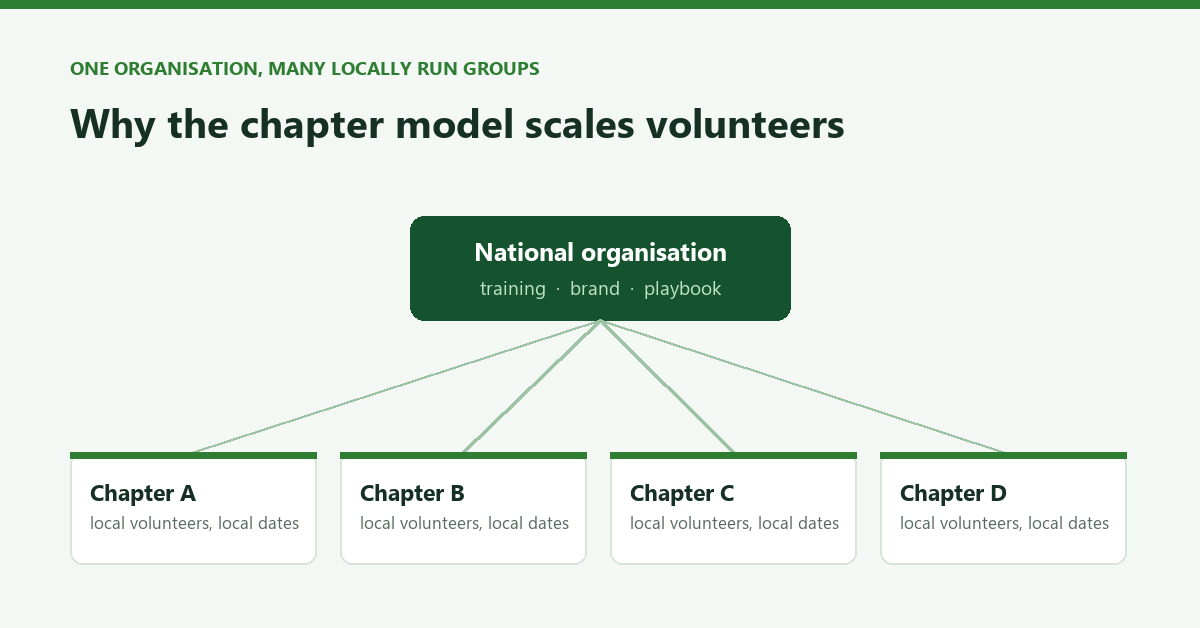
What makes it work is a deliberate split of responsibility. The centre supplies training, the name, the playbook and the credibility. The chapter supplies the local knowledge, the volunteers and the dates. Luke is blunt about where the duty sits: his responsibility, he says, is not to provide beds for the children in your community. That is yours. His job is to tell you there is a problem and that there is a solution.
He even applies it to the website. Visitors do not land on a national homepage, they land on whatever is happening at the chapter nearest them, because the whole design intent is that this is a local thing that happens to have national support behind it.
That is the same reason we organise cleanups the way we do. A cleanup is inherently local: the stretch of road, the volunteers, the business donating the bags and the people who will notice all live within a couple of miles of each other. Central support helps with the parts that are repeatable, and is useless for the part that requires knowing which ditch needs the attention.
The First Event Is Always Smaller Than You Think
Here is where we will be honest in a way that first-time organisers appreciate later: your first cleanup will be small, and that is the correct outcome.
People routinely plan a first event for sixty volunteers, publicise it for three weeks, and get eleven. They then conclude the community does not care. The community cares fine. Eleven is simply what a first event looks like before anybody has seen photographic evidence that this is a real thing that happens and is not awkward to attend.
Plan for the number you will actually get:
- Pick a stretch a dozen people can visibly finish in two hours. A completed short section beats a half-done long one, because the before and after photograph is the recruiting tool for event two.
- Keep it to two hours on a weekend morning. Long enough to matter, short enough that nobody has to rearrange a day.
- Sort the unglamorous logistics first. Bags, gloves, high-visibility vests, water, somewhere to park, and a confirmed arrangement for who collects the filled bags afterwards. The last one is the one people forget, and nothing kills momentum like twenty full bags sitting on a verge for a week.
- Take proper photographs. Wide shots of the site before, the group together, and the same angle after. This is the entire asset you will use to grow the next one.
- Get names and emails on the day. Not for a mailing list in the abstract. For the message that says “we are doing it again on the fourteenth.”
Turning A One-Off Into A Recurring Chapter
A single cleanup is a nice morning. A recurring one changes how a place looks, and the difference between the two is almost entirely administrative.
Three things convert a one-off into something that lasts. First, a fixed cadence that people can remember without being reminded, such as the first Saturday of the month. Ad hoc scheduling means every event has to be sold from scratch. Second, a named second person, so the whole thing does not evaporate when the organiser is away or busy. Luke’s model works precisely because leadership was designed to be handed over rather than held. Third, a record: dates, locations, volunteer counts, and how much was collected. That record is what turns your cleanup from a hobby into something a council, a school or a sponsor can take seriously.
You can see how we structure the recurring version on our events page, and the wider argument for physical events over purely online activity is set out in the power of IRL events for marketing.
What Sponsors Get Out Of Showing Up
Local businesses are usually the ones funding the bags and the coffee, so it is worth being straightforward about what they get, and about what they should not expect.
What they genuinely get: presence in front of neighbours in a context that is not a sales pitch, staff who would rather spend a Saturday morning on this than on a team-building exercise, photographs they can use honestly, and the specific kind of local coverage that follows a visible physical improvement to a place people drive past every day.
What they should not expect: leads on the day. A cleanup is not a lead generation channel and treating it as one is exactly what makes a sponsor’s involvement feel hollow to everybody standing there. The businesses that get the most out of this are the ones that turn up in old clothes and pick up litter alongside everyone else.
If you want to talk through a first event where you live, or sponsor one that is already scheduled, you can book a time with us here. More about how we work is on our about page.
The bar Luke set is genuinely as low as he says it is. Somebody got off the couch. That was the whole qualification.